The post-Soviet era would mark a new “post-modern” reality of unchallenged American hegemony, now riding high on the “end of history”—yet another Hegelian theme that found (strained) usefulness in attempts to explain the rapid succession of events between 1989 and 1991. In attempting to “contain” the Soviet Empire, however, European and American powers would find themselves fighting increasingly asymmetric wars quickly degenerating into regional quagmires. Not able to openly confront Soviet power on a hot battlefield for fear of rapid escalation to nuclear war—and therefore global catastrophe—the West and the USSR had to fight by proxy, with European or American forces engaging in direct hot conflict with lesser regional powers backed by the Soviets, in order to gain strategic advantage.
After a series of mostly failed attempts to check Soviet strategic advance by armed military interventions, with Vietnam being the signal moment, these direct hot tactics would effectively ramify, in these heady years of newfound American-led “Western” hegemony, into a new doctrine of war—a kind of “post-modern” war strategy, driven by a new political and economic consensus among Western powers that would in time come to be called “neoliberalism”. The post-modern neoliberal doctrine of warfare was now primarily driven by the attempt to negate by forcible political-economic means what could not be done directly by pure military means (invasion and regime change). Thus this warfare was conducted through what Naomi Klein accurately described as a “shock doctrine”: create or promote the conditions of immediate political and economic crisis through subterfuge (perhaps supporting a military coup or junta, as the CIA infamously did in Chile), then move in with the economic shock team ready to institute the essential architecture of the neoliberal order: “free markets” and so on. We may call this “post-ideological” warfare by other means. But of course since the “ideology”, like the water of a fish’s environment, was everywhere—after all capitalism has “no alternative”, as Thatcher would famously remark—this was ideology at its purest.
This strategy would, however, lead to increasingly more bitter disappointment and open rage among states first supported by the West but which ended up (for predictable reasons) failing. In the late 1970s and into the 1980s and 90s, Iran and the Middle East would become the high-watermarks of failed Western neoliberal interventionism, with much of the blood on American hands. But with the 9/11 attacks on US soil, this post-modern strategy would take on new and more troubling dimensions. It would become both more openly vicious and yet more nebulous a form of conflict. Indeed, it would switch targets from a relatively well-defined ideological aggressor (communism), with a clear power-center, to an ill-defined, diffuse opponent: “terror”. It had now become even more purely ideological, a kind of twisted idealism absurdly defining itself against a concept. The “War on Terror” would be the new ideological background to a neoliberal political-economic strategy that would quickly find itself out to sea, having lost its original motivation. Indeed, the “War on Terror”, being such a diffuse concept to begin with, soon becomes a cypher for all manner of islamophobia or outright racism, further exacerbating an already tragic story. By the second decade of the 21st century, this bellicose neoliberal strategy seemed tired, even outmoded, as Russia and China emerged as serious military or economic rivals to the Western US-led alliance, demonstrating quite clearly that the marriage between capitalism and democracy needn't be so secure (not especially as secure as the once-fringe neoliberal apologists, like Milton Freedman, had long argued).
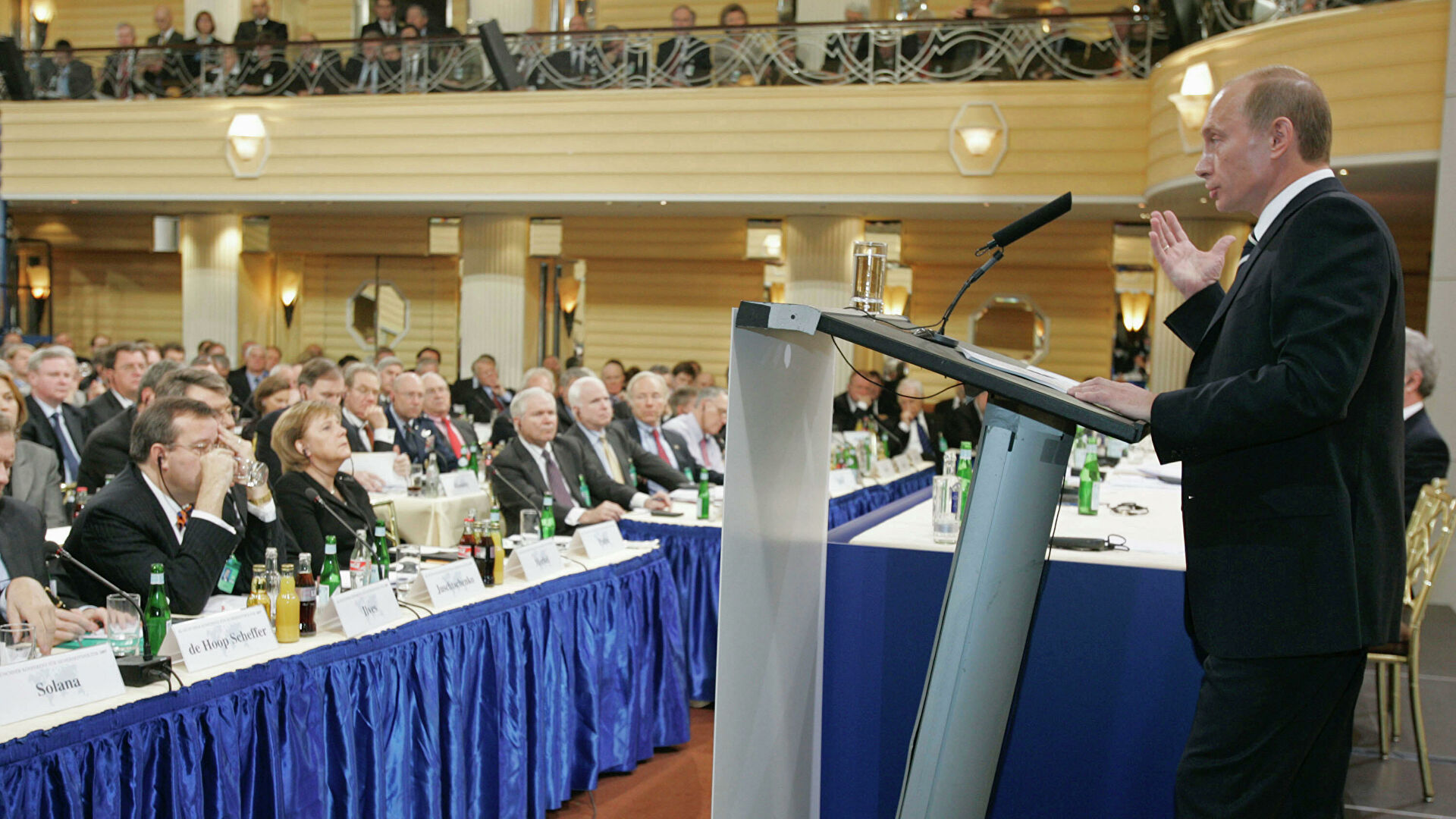
The return to clearly-defined ideological dividing lines, so characteristic of the “modernity” of the war years, was inaugurated by the most nostalgic of the West’s challengers: Vladimir Putin. The 2007 speech delivered by an indignant Putin to the Munich Security Conference marks the beginning of the end of the “post-ideological” age of untrammeled, US-led neoliberal “shock” tactics “spreading democracy and freedom around the world”. In that post-modern age of the “end of history”, the rhetoric of democracy and freedom surrounding the political, economic and moral realities of this interventionist neoliberal shock therapy could only be met with (justifiable) cynicism. But the danger we now face is failing to drop the cynicism in response to rapidly changing ideological circumstances: we are now fast moving back(ward) into the old world of symmetric conflict among nuclear-armed powers, with suddenly very sharply defined—and I would argue authentic—ideological differences between them. The nebulous era of post-modern cynicism, with its endless (albeit well-motivated) critiques of neoliberalism from the academic Left, is now no longer tenable. We are back in a very “modern”—and unfortunately all-too-familiar—world.
Indeed, it is perhaps the most profound of ironies (and an overdetermined one, to be sure) that a figure such as Putin, steeped as he is in late-nineteenth century Russian fascist social philosophy, would be the political figure to usher us back into the world we thought we had left behind at the falling of the Berlin Wall. It is a very Nietzschean moment, when Nietzsche was at his metaphysical best: we are seeing a repetition with a difference. Or perhaps we are witness once again to (and here we pile irony on top of irony) Marx’s famous quip about what Hegel missed in his speculative theory of history: it repeats itself indeed, but first as tragedy, then as farce. The farce now is that modernity is here once again, and our negative identities are coming back to us like they never left us. But like during World War II, we now cannot afford or risk moral or philosophical cynicism regarding “The West” and its once hollow-seeming rhetoric of democracy and freedom. At the level of the new and emerging political realities, that ideology of “democracy and freedom”, which was once convenient cover for the covert operations of neoliberal tacticians and their war by other means (a fact that is key to the ongoing hostility and bitterness towards “The West”), is now deadly serious. There are now profoundly consequential political-ideological dividing lines to fight for as the world seems to want to shift to the autocratic right. These lines in democracy’s favor are now being actively fought for by the Ukrainians on a very hot early Spring battlefield.
“Democracy” and “Freedom” are, then, suddenly very meaningful; they can now justifiably be detached from that cynicism which only hears the cries of the hypocrite as “Western” powers voice their concerns over the war in Ukraine. They are suddenly very real concepts, with real implications in terms of the fascist autocracy being opposed by the European and American alliance. This alliance is backed by most nations of the world, it should be noted, as demonstrated by the numerous resolutions issued by the UN—a (much-maligned) institution that, in precisely this specific moment in history, takes on an immensely powerful functional and importantly symbolic role. Usually cause for a cynicism towards the UN, the symbolism is here key as its condemnatory resolutions against Putin's Russia establishes that this opposition is not a merely “Western” affair ... as if the many nations of Africa do not look over and see themselves in the Ukraine. The African response, delivered in the earliest of emergency UN sessions, is quite telling: while (rightly) chastising “Western” powers for their hypocrisy vis a vie their own vaunted principles of “freedom” and “democracy”, many African nations nonetheless stood united with Europe and the US in their opposition to Putin’s unprovoked war of aggression. Democracy and Freedom are the unifying principles, even though its most vocal defendants are some of its most morally shameful claimants.
The subtleties of academic criticism, with its (perhaps justifiable) moralism directed against American hegemony, or the sincere effort to balance vociferous Russian condemnation with an objective evaluation of its “very real security concerns” over Nato’s hugging of Russia's western borders, are simply no longer tenable, for Putin’s jig is up, and the bluff is being called: “security concerns” and the like are Putin’s own ideological cover for something much more sinister, as outlined in the now-infamous “Ukraine” essay Putin issued in the summer of 2021. In classic, modernist fascist style, Putin paints the picture of his ideological struggle, his Mein Kampf moment: Ukraine is a fake country given up by the soft-hearted Khrushchev (himself of Ukrainian descent), a deal finally (and hastily) sealed by Yeltsin during the chaotic breakup of the Soviet Union. In short, Ukraine should have never existed in the first place; it is the homeland and origin of all Russian peoples everywhere. It is Russian. It is Russia. And we are Ukraine’s liberators, from its neo-Nazi fascist nationalist defenders. In other words, have we not a repeat with (a hyper-fake social media propaganda engine of) a difference? Hitler’s early move on Czechoslovakia (the Sudetenland), then on to Poland and beyond? We must beware the liberal-leftist tendency to be blinded by its own ideology: that of progress, which would reject the (more ironically conservative) Nietzschean principle of repetition with a difference ... more of the same, with some change thrown in for comedy’s sake (as Marx would realize). If we are to love our fate, then we must be able to love it even while that fate laughs in our face, chastening us of our stupid “progressive” dreams. The old non-progressive world is still with us, lurking in the shadows of our triumphalist progressivism.
We must rise to the challenge, and be strong (and humble) enough to meet fascist “strength” with the strength of our own ideology of democracy and freedom: the freedom to be left alone to democratically determine the conduct of our own affairs—something that, against fascist autocracy, actually means something, something which cuts through any lingering cynicism. Can we not see the hollowness of Putin’s “security concerns” just when we can see the hollowness of our own commitment to “freedom” and “democracy” mouthed in the face of the uncomfortable fact of neoliberal shock tactics? Putin's war gives us the negative identity freedom and democracy itself needs: we—European, African, American, Asian people the world over who have thus voted in the majority—don’t want the oligarchic, mafia-style state that is de rigueur in Russia today. Ukraine, as many former soviet republics were, was headed down that road, to which the Ukrainian people voted “no!”. We say “no!” to Putin’s Russia, and ask that Russia itself be liberated from the iron grip of Putin’s fascist autocracy.
If it’s not possible to be (without cynicism) for democracy, then let’s at least be against fascist autocracy. We in the “West” can worry over our sorry neoliberal state once the war is over, and we can resume our quiet lives of (first-world) desperation.
The only question is: what will the free world do the day after the victory party is over?



No comments:
Post a Comment