Friday, March 25, 2022

Exiting Asymmetric War: Post-Cynical Democracy

Among the many insights Hegel had into the human psyche was the concept of negative identity. World War II was the catalyst for negative identity the world over. Allies came to define themselves against Nazi aggression, and eventually against Japanese fascist imperialism. But identity is more complex, of course. Those same Allies would diverge in terms of what they defined themselves as, positively. Following the end of WWII, there was an identity crisis. It was quickly remedied by the Cold War: European and American powers defined themselves against the quickly strengthening Soviet Union, soon armed with nuclear weapons, and its Communist ideology. Stalin would prove to be as murderous as Hitler and the Nazis had been, if not far worse: gulags, purgings, preventable famines, and state-engineered machinery for domestic fear and terror—all this in the years and decades following the end of the war. In 1989, this negative identity would come to an end, with no clear adversary in sight to restore the need. In quick succession East Germany comes apart at the seems overnight with no response from Moscow. Putin, stationed as a low-ranking counterintelligence agent in Dresden would call for backup as the protesters set their sights on his KGB building; “Moscow is silent” would be the reply from the desk officer. By 1991 there was no Soviet Union. The American psyche, consciously celebrating the downfall, suffered a shock to its unconscious. That shock would come to define the US, as it found itself virtually unchallenged as world hegemon.

The post-Soviet era would mark a new “post-modern” reality of unchallenged American hegemony, now riding high on the “end of history”—yet another Hegelian theme that found (strained) usefulness in attempts to explain the rapid succession of events between 1989 and 1991. In attempting to “contain” the Soviet Empire, however, European and American powers would find themselves fighting increasingly asymmetric wars quickly degenerating into regional quagmires. Not able to openly confront Soviet power on a hot battlefield for fear of rapid escalation to nuclear war—and therefore global catastrophe—the West and the USSR had to fight by proxy, with European or American forces engaging in direct hot conflict with lesser regional powers backed by the Soviets, in order to gain strategic advantage.

After a series of mostly failed attempts to check Soviet strategic advance by armed military interventions, with Vietnam being the signal moment, these direct hot tactics would effectively ramify, in these heady years of newfound American-led “Western” hegemony, into a new doctrine of war—a kind of “post-modern” war strategy, driven by a new political and economic consensus among Western powers that would in time come to be called “neoliberalism”. The post-modern neoliberal doctrine of warfare was now primarily driven by the attempt to negate by forcible political-economic means what could not be done directly by pure military means (invasion and regime change). Thus this warfare was conducted through what Naomi Klein accurately described as a “shock doctrine”: create or promote the conditions of immediate political and economic crisis through subterfuge (perhaps supporting a military coup or junta, as the CIA infamously did in Chile), then move in with the economic shock team ready to institute the essential architecture of the neoliberal order: “free markets” and so on. We may call this “post-ideological” warfare by other means. But of course since the “ideology”, like the water of a fish’s environment, was everywhere—after all capitalism has “no alternative”, as Thatcher would famously remark—this was ideology at its purest.

This strategy would, however, lead to increasingly more bitter disappointment and open rage among states first supported by the West but which ended up (for predictable reasons) failing. In the late 1970s and into the 1980s and 90s, Iran and the Middle East would become the high-watermarks of failed Western neoliberal interventionism, with much of the blood on American hands. But with the 9/11 attacks on US soil, this post-modern strategy would take on new and more troubling dimensions. It would become both more openly vicious and yet more nebulous a form of conflict. Indeed, it would switch targets from a relatively well-defined ideological aggressor (communism), with a clear power-center, to an ill-defined, diffuse opponent: “terror”. It had now become even more purely ideological, a kind of twisted idealism absurdly defining itself against a concept. The “War on Terror” would be the new ideological background to a neoliberal political-economic strategy that would quickly find itself out to sea, having lost its original motivation. Indeed, the “War on Terror”, being such a diffuse concept to begin with, soon becomes a cypher for all manner of islamophobia or outright racism, further exacerbating an already tragic story. By the second decade of the 21st century, this bellicose neoliberal strategy seemed tired, even outmoded, as Russia and China emerged as serious military or economic rivals to the Western US-led alliance, demonstrating quite clearly that the marriage between capitalism and democracy needn't be so secure (not especially as secure as the once-fringe neoliberal apologists, like Milton Freedman, had long argued).

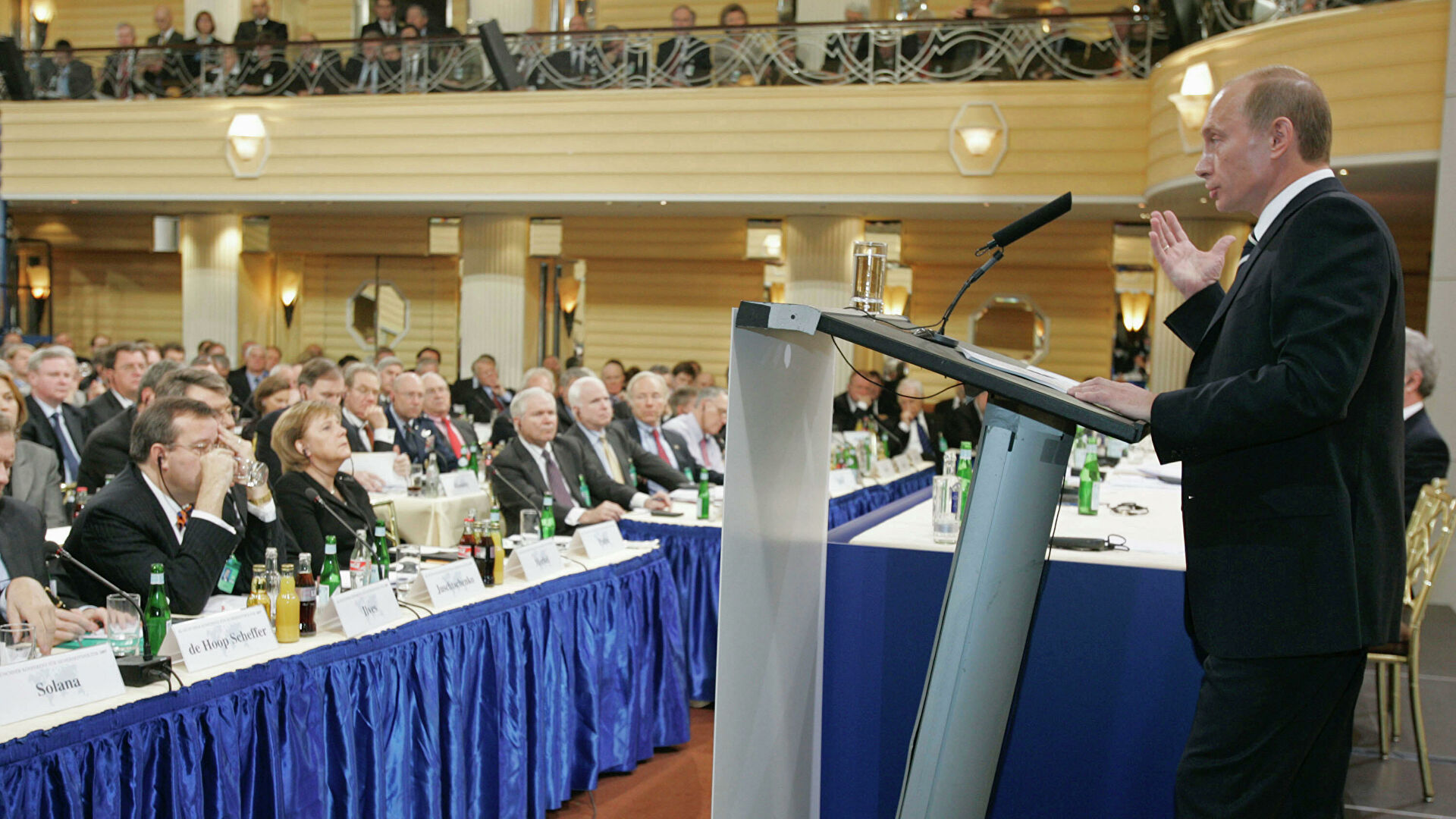
The return to clearly-defined ideological dividing lines, so characteristic of the “modernity” of the war years, was inaugurated by the most nostalgic of the West’s challengers: Vladimir Putin. The 2007 speech delivered by an indignant Putin to the Munich Security Conference marks the beginning of the end of the “post-ideological” age of untrammeled, US-led neoliberal “shock” tactics “spreading democracy and freedom around the world”. In that post-modern age of the “end of history”, the rhetoric of democracy and freedom surrounding the political, economic and moral realities of this interventionist neoliberal shock therapy could only be met with (justifiable) cynicism. But the danger we now face is failing to drop the cynicism in response to rapidly changing ideological circumstances: we are now fast moving back(ward) into the old world of symmetric conflict among nuclear-armed powers, with suddenly very sharply defined—and I would argue authentic—ideological differences between them. The nebulous era of post-modern cynicism, with its endless (albeit well-motivated) critiques of neoliberalism from the academic Left, is now no longer tenable. We are back in a very “modern”—and unfortunately all-too-familiar—world.

Indeed, it is perhaps the most profound of ironies (and an overdetermined one, to be sure) that a figure such as Putin, steeped as he is in late-nineteenth century Russian fascist social philosophy, would be the political figure to usher us back into the world we thought we had left behind at the falling of the Berlin Wall. It is a very Nietzschean moment, when Nietzsche was at his metaphysical best: we are seeing a repetition with a difference. Or perhaps we are witness once again to (and here we pile irony on top of irony) Marx’s famous quip about what Hegel missed in his speculative theory of history: it repeats itself indeed, but first as tragedy, then as farce. The farce now is that modernity is here once again, and our negative identities are coming back to us like they never left us. But like during World War II, we now cannot afford or risk moral or philosophical cynicism regarding “The West” and its once hollow-seeming rhetoric of democracy and freedom. At the level of the new and emerging political realities, that ideology of “democracy and freedom”, which was once convenient cover for the covert operations of neoliberal tacticians and their war by other means (a fact that is key to the ongoing hostility and bitterness towards “The West”), is now deadly serious. There are now profoundly consequential political-ideological dividing lines to fight for as the world seems to want to shift to the autocratic right. These lines in democracy’s favor are now being actively fought for by the Ukrainians on a very hot early Spring battlefield.

“Democracy” and “Freedom” are, then, suddenly very meaningful; they can now justifiably be detached from that cynicism which only hears the cries of the hypocrite as “Western” powers voice their concerns over the war in Ukraine. They are suddenly very real concepts, with real implications in terms of the fascist autocracy being opposed by the European and American alliance. This alliance is backed by most nations of the world, it should be noted, as demonstrated by the numerous resolutions issued by the UN—a (much-maligned) institution that, in precisely this specific moment in history, takes on an immensely powerful functional and importantly symbolic role. Usually cause for a cynicism towards the UN, the symbolism is here key as its condemnatory resolutions against Putin's Russia establishes that this opposition is not a merely “Western” affair ... as if the many nations of Africa do not look over and see themselves in the Ukraine. The African response, delivered in the earliest of emergency UN sessions, is quite telling: while (rightly) chastising “Western” powers for their hypocrisy vis a vie their own vaunted principles of “freedom” and “democracy”, many African nations nonetheless stood united with Europe and the US in their opposition to Putin’s unprovoked war of aggression. Democracy and Freedom are the unifying principles, even though its most vocal defendants are some of its most morally shameful claimants.

The subtleties of academic criticism, with its (perhaps justifiable) moralism directed against American hegemony, or the sincere effort to balance vociferous Russian condemnation with an objective evaluation of its “very real security concerns” over Nato’s hugging of Russia's western borders, are simply no longer tenable, for Putin’s jig is up, and the bluff is being called: “security concerns” and the like are Putin’s own ideological cover for something much more sinister, as outlined in the now-infamous “Ukraine” essay Putin issued in the summer of 2021. In classic, modernist fascist style, Putin paints the picture of his ideological struggle, his Mein Kampf moment: Ukraine is a fake country given up by the soft-hearted Khrushchev (himself of Ukrainian descent), a deal finally (and hastily) sealed by Yeltsin during the chaotic breakup of the Soviet Union. In short, Ukraine should have never existed in the first place; it is the homeland and origin of all Russian peoples everywhere. It is Russian. It is Russia. And we are Ukraine’s liberators, from its neo-Nazi fascist nationalist defenders. In other words, have we not a repeat with (a hyper-fake social media propaganda engine of) a difference? Hitler’s early move on Czechoslovakia (the Sudetenland), then on to Poland and beyond? We must beware the liberal-leftist tendency to be blinded by its own ideology: that of progress, which would reject the (more ironically conservative) Nietzschean principle of repetition with a difference ... more of the same, with some change thrown in for comedy’s sake (as Marx would realize). If we are to love our fate, then we must be able to love it even while that fate laughs in our face, chastening us of our stupid “progressive” dreams. The old non-progressive world is still with us, lurking in the shadows of our triumphalist progressivism.

We must rise to the challenge, and be strong (and humble) enough to meet fascist “strength” with the strength of our own ideology of democracy and freedom: the freedom to be left alone to democratically determine the conduct of our own affairs—something that, against fascist autocracy, actually means something, something which cuts through any lingering cynicism. Can we not see the hollowness of Putin’s “security concerns” just when we can see the hollowness of our own commitment to “freedom” and “democracy” mouthed in the face of the uncomfortable fact of neoliberal shock tactics? Putin's war gives us the negative identity freedom and democracy itself needs: we—European, African, American, Asian people the world over who have thus voted in the majority—don’t want the oligarchic, mafia-style state that is de rigueur in Russia today. Ukraine, as many former soviet republics were, was headed down that road, to which the Ukrainian people voted “no!”. We say “no!” to Putin’s Russia, and ask that Russia itself be liberated from the iron grip of Putin’s fascist autocracy.

If it’s not possible to be (without cynicism) for democracy, then let’s at least be against fascist autocracy. We in the “West” can worry over our sorry neoliberal state once the war is over, and we can resume our quiet lives of (first-world) desperation.

The only question is: what will the free world do the day after the victory party is over?

Thursday, March 24, 2022

If Not For Democracy, Then Against Autocracy

What bits I am reading from some of the academic elites on the Left are truly sad, showing little moral clarity (for example, consider Tariq Ali’s recent LRB piece, or David Harvey’s “preliminary” statement on the Ukraine war published in various online forums). Rather than clearly and without qualification denouncing the aggression itself, they seem mostly intent on using the war in Ukraine as an opportunity to rehearse their cynicism or hatred of either democracy, capitalism, "The West", Nato, the US or some combination thereof. Indeed, a profound cynicism suddenly appears in the leftist critiques of "Western Powers" or of Nato as a military organization ostensibly created to ensure the security of liberal democracies from the Americas to Europe. Surely such cynicism is motivated by decades of disastrous American and European interventionism, driven primarily by the agenda set by the US -- seen (with justification, of course) as global hegemon. It is on the whole a very difficult issue to analyze, and certainly impossible here. But I feel that at least some passing remarks are in order about this moral or political cynicism directed towards the US and "Western Powers"...

To begin with, to lay blame, as Tariq Ali does, at the feet of "Western Powers" for, among other things, the catastrophes of the Middle East (to take but one example) is surely too blunt and unsophisticated a position to take, especially for a proper leftist intellectual: surely we should not think in absolute, monolithic terms like "The West" or "Western Powers". Usually, such monoliths in leftist critiques (like from Ali) evince a rage that should more properly be directed specifically to the United States and its foreign policy blunders, or to other European nation-states (France? The U.K.?) that have ruinously mucked around Africa and the Middle East (the US has especial fondness for foible in Latin America, of course). Using a term like "The West" is dangerously close to that fascistic language of liquidation, erasure and purgation endemic to totalitarianisms the world over. Tariq Ali, the eminently cultured British historian and critic of "The West" (born in Lahore, in British Raj) easily slides between the specific and the abstract, an elision that one could easily see transmuted, in his own Marxist utopia, into a morally charged purgation of the undesirables (those perhaps like myself who still believe, perhaps naively, in liberal democracy and the need to actually defend it).

But speaking of the defense of liberal democracy: it is equally sure that its defense on the international stage cannot be undertaken by support from wholly unalloyed defenders. At the level of those nation-states like the US, who voice a belief in liberal democracy, one can only hear the cries of the hypocrite, for how many of those same nation-states defending liberal democracy have seen to it to invade or interfere in the democratic processes of other nation-states deemed threatening, for one reason or another (in Chile, in Afghanistan, in Iran, Iraq, and so on)? This is at the heart of the many leftist critiques of "The West" now being rehearsed as the forces of authoritarianism bear down on the Ukraine...

I, however, wish to speak on behalf of the alloyed defenders of liberal democracy, against the leftist critics and against leftist critiques in general. Now is not the time to rehearse “The West’s” moral and political failings—a criticism which is surely just, as far as it goes. (Who can deny the litany of atrocities, botched invasions, foreign policy blunders and ensuing "blowback", as the late CIA analyst Chalmers Johnson so famously warned about the further long-term consequences of the US invasions of Afghanistan and Iraq?) But in the real world of real politics, nothing is unalloyed, nothing blameless; as that underappreciated defender of democracy, Benedict Spinoza, pragmatically accepts as necessary in the realm of statecraft: we're always having to choose between the lesser of two evils. What is missed in this forced choice is that we must simultaneously choose between the better of two ideals as we choose between the lesser of the two evils. At the same time we're choosing between the lesser of two evils in the real world, we're having to decide which of those evils realizes the better of two ideals in the world of political ideas. Should we then, as we list the foibles of “The West” in recent decades also not list, for completeness, the many atrocities committed by “non-Western” nation-states the world over—some of whom fear for their “security” as Nato nears? Shall we work through the menu of horrors those authoritarian regimes have perpetrated against their own people or their neighbors, they—nearly half the world, as Tariq Ali so carefully reminds us liberal Western democrats—who were so unified in their silent abstentions in the recent UN General Assembly convened to issue its denunciation of Putin’s war of aggression?

It is not only the US and most of Europe who are the (quite alloyed) defenders of the ideal of liberal democracy; in fact, they are not the real defenders of it at all so much as they stand in opposition to its direct negation, its challenger in the Russian Federation. We are not "defending freedom", nor are we defending liberal democracy per se. We stand, rather, united to oppose its destruction, its negation at the hands of those demonstrated illiberal autocrats who want not merely to command and control their near-neighbors, wresting any potential Nato ally from their borders, but to also gain in actual geography what they believe only in ideology (that Ukraine is really Russian, and always has been—a position Tariq Ali himself, by the way, comes chillingly close to endorsing in his overstuffed erudition in response to questions following his 2015 LRB Winter Lecture). And “we” are the other half of the world, the many Western and non-Western nations and peoples of the planet Earth who desire democracy over autocracy…

The leftist academic elites love to hate Nato, perhaps only second to their love to argue for the downfall (or dysfunction) of the American Empire (which surely is right: the US is a domestic social and political basket-case). But what about Nato? What about that "Empire"?

Nato is most certainly driven by various political and even economic aims (if only indirectly) that are not necessarily consistent with the ideals of liberal democracy. That's not really much of a surprise for a military organization as such. But equally surely the moral calculus of this military alliance is clear: it is not an engine for genocide, conquest or the usurpation of power. It expands through voluntary membership. Who sees Nato as a "security risk" are those opposed not necessarily to "The West" (or to the US or Europe even), but those who really fear that their own illiberal means or dreams might be squeezed by that alliance. In short, those who find Nato to be a "security concern" are precisely those who have a lot to loose from a liberal democracy taking root in their own land: the autocrats, the authoritarians. The list of those abstaining from the (moral) denunciation of Putin's (I don't say "Russia's") war of aggression against Ukraine, which Tariq Ali breezily flourishes past his readers' eyes as evidence of "half the world's" opposition to "The West", gives us a nice menu of contemporary authoritarianism: China, India, Cuba, etc. ... all led by authoritarians, all uneasy with (or in open hostility towards) liberal democracy.

And as for that "Empire" the left loves to hate, the US: it is in the unfortunate position, since the end of the Second World War, of being the global hegemon, with a powerful and energetic (and even resilient) economy backed by a powerful military, while also constituting, in the eyes of the rest of the world, the premier representative of liberal democracy. But it is also a basket-case, riddled with internal social, political and socioeconomic discord which its rivals (and enemies) revel in -- and, in the case of Putin's Russia, have even taken pleasure in directly making far worse (I mean of course the mercenary army of hackers Putin hires to flood American social media with all manner of disinformation: "fake news"). It is also a nation that has in a sense committed the original sin of the modern, technoscientific era: it is the only nation to have dropped nuclear bombs on another nation, a fascistic imperial monarchy, with dreams of regional conquest of its own, that was consequently chastened by not one but two bombs, which left scores of innocent people burned, dead or dying. What, though, was America's "imperial" dream?

The Marshall Plan, for the restoration of Europe. Germany, actually de-nazified and demilitarized (the absurd war cries now used by Putin to justify his invasion of Ukraine ... one justification among a twisted many). Japan, stripped of its fascism, and turned over to its own governmental affairs -- only to become in time a once-feared economic rival to the US. But then what? Fears over the spread of Communism then launch the US on its disastrous decades-long stretch of interference in the politics of nation-states it worried would fall out of the liberal democratic-capitalist economic order -- the system saved by FDR and Churchill, but wholly opposed by Stalin. Surely that system had visible evidence in its favor: the raising of standards of living; overall economic vitality; fuller employment; bounteous food, clothing and consumer goods; technological and intellectual innovation. But this heady dynamo of social, cultural and economic activity, now spreading its influence like wildfire throughout the globe (the "soft" power the US would come to wield), would run up against the moral and political limits designed and imposed by the post-war saviors of this very system. Globalization, and the "Free Trade" movement, along with its accompanying socioeconomic philosophy, dubbed "neoliberalism", would produce discontent at home and abroad, leading to more interference in the political affairs of those sovereign states not yet brought into alignment with this vision, leading in turn to more discontent, fueling reaction to its excesses and clear moral failings. The US, now playing the game everyone else was playing (including China and post-Soviet Russia), found itself not only as global hegemon but also keeper of the flame of liberal democracy as it discredited that keepership by indulging its desires for the "containment" of troublesome communist- or socialist-leaning nation-states (with their populist uprisings), deemed too unruly for the staid logic of the new neoliberal order of the day: free-wheeling capitalist democracy (and anyone willing to play nice with us).

Yet, despite these undeniable facts, despite the twisted logic of the neoliberal order, in its doubling-down on the cold logic of casino capitalism, and the persistent failure in the US to explore or experiment with viable alternatives (or to even consider implementing the mitigations of northern European-style social democracies, with their tame, but functioning, socialist principles morally structuring vibrant capitalists economies), the US along with Europe and much of the rest of the world, not only want some form of democracy, they want to defend against its opponents. I am not so cynical as to think that this is not sincerely desired, and I am not so cynical to think that we who join in this call to support (and even directly defend) Ukraine as a democracy under siege are not sincerely opposed to the illiberal authoritarians taking aim at that nation. Why are we not allowed to voice this desire for democracy? To defend it? To oppose the autocrats? Must we on the Left have to take upon ourselves the burden of having to chant mea culpas for the illiberal wrongs of supposedly liberal democratic states, governments, empires, before we can defend our cherished but imperfectly expressed ideals?

There really is a choice here, as "Manichean" as some leftists try to dismiss it as: liberal democracy of some kind, joined with a more or less morally restrained capitalism v. illiberal authoritarianisms of various sorts playing at the capitalist game, with none of the social and political openness (capitalist) democracies enjoy. We may certainly desire radical alternatives to the existing order, and we would be right to do so. But I prefer to live and work in a society where I have the freedom to think those alternatives openly (even though it might go ignored or unrecognized, for lack of interest), to write, publish and think without fear of imprisonment or death. And I also prefer to live, work and think in a society where we might debate and protest towards an alternative, where experimentation might be possible. Indeed, a space (a political, economic and social one) of experimentation should be our immediate goal, not the restless rehearsal of the same old critiques of American or European Power (as important as they were, when they were fresh) -- not especially by those like Tariq Ali who enjoy the comforts these societies afford. (The timeless irony of these leftist critics is, as Adorno once observed, that they need the luxury of the liberalism (the "system") they so astutely subject to critique.)

Which of course brings us finally to the deeper problem with the left and with much of the academic leftist critiques in general: what have we to offer, in terms of a positive, affirmative political, social and economic program? Therein lies the rub, for such is never the design of one mind, or of many, but the chaotic working out of the contingencies of history, about which the intellectual, always arriving to the party too late, has the benefit of lots of hindsight. The comfortable perch from atop of which someone like Tariq Ali can gaze, critically, against the whole of "The West", and easily pronounce its (by now well-established) failures only induces one to scrutinize their own commitments, in theory or practice. And rather than original wisdom, you find an easy mélange of notions culled from the recesses of intellectual history: Marxism (but could it ever be democratic?), or, in others, some form of anarchism, or communalism, and so on. Perhaps one day...

What is so irksome is just the lack of authentic political will or, more fundamentally, real political theory (that is not fraught with idealisms of one form or another) on the Left. What is needed is more experimentation, and the political will that goes along with it as a mobilizing force. But what is also needed, in my view, is a reconsideration of the foundation and proper articulation of democracy itself. In terms of a practiced political and social form, it is by far the one with the fewest years to its name. Far more time has been spent under the heel of monarchy, or its more recent incarnation, the despotic authoritarianisms of the 20th and 21st centuries. Democracy may be an ancient idea, but it is an all-too-young and therefore all-too-fragile practice, one whose inner potential has perhaps not yet been fully determined.

One cause of our moral and intellectual failure of imagining new democratic forms is, perhaps, the contingent political-economic form that grew up together with it: capitalist democracy, with its morally neutered goal of the infinite accumulation of accumulating capital (to borrow Wolfgang Streeck's definition), may well prove to be a very long detour in the history of democratic social-political arrangements. But surely there are other political-economic arrangements that, while eschewing the logic of the accumulation of capital as absolute goal, are nonetheless structured to both meet the needs of its people, and to be vital and vibrant enough to be "productive", progressive even. I for one want to give it a fighting chance, and that means we must fight for it. How? Real politics requires real action, and that means that we must use force to oppose those who would impose their illiberal ideals on the unwilling. Surely this means that we ought not to impose it on others, but to lead by the shining example of the productivity of markets and the freedoms of those societies. But of course, this is far from the case, as we in "The West" have sought to impose democracy, certainly capitalist democracy, on the unwilling. This wrong, however, doesn't justify another and we in "The West" must be absolutely clear on that point: the undemocratic failings of the democrats shouldn't be cause to curl up and allow the illiberal autocrats to take what they want. Absolutely not. We stand, if not specifically, and with unalloyed moral resolve, for democracy, then we most certainly stand against the autocrats with their "security concerns". What do we have to oppose autocracy, if not, under the conditions of a war of aggression, with a military power to back up our desire for democracy, however flawed, to be preserved -- as an idea yet to be fully and faithfully deployed for the benefit of humankind?

Democracy: Exercises In Nonexistence

I think we all well understand this issue, and do so on a very intuitive level, but perhaps cannot see it in clear enough outline that we are disturbed by it, and perhaps moved to action. The issue is this: that the most profound and profoundly disturbing of ironies of American Democracy (so-called) is that its essential engines of social and material power (corporations, financial institutions, and all private enterprise) are radically and unapologetically UNDEMOCRATIC. No, they are ANTI-DEMOCRATIC—even interested in actively suppressing any movement towards a more democratic form of organization and expression. Except for a very narrow range, their activities are unconstrained and unfettered by any semblance of a democratic system of debate, negotiation and compromise.

It might come as a surprise to state it like this, but consider a private (or even "public") corporation: it is an entirely autocratic, hierarchical arrangement of persons driven by one overriding imperative (profit), where the majority of persons have no direct say in its daily operations, nor do they have recourse even to the most elementary structures of modern democracy (a representative body of elected officials legislating and enforcing policy to which the represented participants are themselves subject).

Somehow, of course, the acceptability of this autocratic structure of corporations is derived from a principle of freedom and private property; but the slide from individual freedom and private ownership, to a collective organization that negates that freedom (and ownership) for the majority of the corporate body itself is dubious at best, irrational (and inhuman) at worst. But the fact is that the corporation itself, being eventually constituted by an organized body of persons collectively participating in the work that is the corporation’s essence and foundation, moves through a process of transformation whereby what was originally a private exercise of freedom and private ownership (by the founder or founders) becomes a collectively "owned" thing no longer beholden to a single person with their singular interests, but to the whole which is its actual, working reality. In other words, from individual freedom and private property we arrive in a few steps at a concept of collective ownership and a system of organization and management which is a generalization of individual freedom, not a negation of it. It should, then, follow that no corporation could justifiably exist without a democratic structure in place as its operating reality. Yet, somehow, such does not and (with few exceptions) has not existed in the history of modern capitalist society. (The same analysis can be made, mutatis mutandis, for the other engines of American democracy: financial institutions and, in general, all private enterprise.)

What I have attempted to outline, in a somewhat abstract way, is so obvious that perhaps my abstractions obscure the fact. It's perhaps worth stating again, more plainly: does anyone find it utterly absurd that, in the most powerful democracy on the planet (supposedly), every financial, corporate or private institution with which we interact, and on which the democracy survives, save for government itself, is autocratic, hierarchically arranged, more or less authoritarian in nature and therefore radically anti-democratic? (We can make an argument that, of course, even government itself is only very imperfectly "democratic", if at all.) In other words: the U.S. (and many other putatively democratic states) is democratic in its political principles and ideals, but is radically anti-democratic in its actual material economic realities. One is tempted to say that the operating principle of modern democracy is the paradoxical dictum that says that: In order to be democratic in theory, you have to be anti-democratic in practice. This calls to mind one of Mark Twain's sadly funny witticisms: "It is by the goodness of God that in our country we have those three unspeakably precious things: freedom of speech, freedom of conscience, and the prudence never to practice either of them"—adding to Twain’s unfortunate list, of course, democracy itself.

As a mere "employee" you have little say in the ultimate or final structure, functioning, or daily operating strategies of the business or corporation which employs you (this applies even to the "corporations" I work for: academia). Everything you do, every decision you make, is subject to final approval by someone who has absolute power to overturn the aforementioned at will, even arbitrarily. There is little anyone can do about it. There is no (again with few exceptions, which are narrowly defined when they exist at all) appeal board, no process of debate or reconsideration. There is even no system where you, as employee, participate in the creation of the policy structure to which you are subject (again with few exceptions which in every case are always themselves subject to the arbitrary whim of someone higher in the ladder of internal corporate power). There is always someone, or some very few persons, who have absolute and unchallenged (and even unchallengeable) power over the vast majority of the corporate body. Again, the same is true for financial institutions, and for all private enterprise whatsoever.

This is what many, even classical liberal, thinkers have called into question: not private property per se, but private ownership of something which must of its own nature become and remain a collective effort (which is most business conducted for the benefit, and with the help, of others). As soon as you, conducting your own labors, in the creation of something materially beneficial and useful for yourself and others, require the assistance of another, then that thing being created is mutually or collectively owned—by the same principle out of which you derive the sense that the thing on which you personally and solely worked is your own. If you work the land yourself, then it would be yours; if you require the assistance of others, then you must give to them a portion of its ownership, such that it then becomes owned by all who so participate in the work. It follows that very few things can be actually personally "owned". Of course, unless even the clothes on our backs and the table and chair I'm now using be considered shared and available for use at any moment, considered collective property, there must be some sense of a fair or just relinquishment (technically, dispossession) of collective ownership for personal possession and unchallengeable use. There must be some concept of personal (not necessarily "private") property. That should be a matter of a kind of contractual (mutual) agreement, mediated by fair exchange (thus the use of an abstract universal means of exchange: money). But, this dispossession must and should have limits; it should not and indeed cannot be extended to the means by which things are produced, a means which is by its nature a collective endeavor and therefore, by our earlier principle, a thing necessarily collectively owned. I may take possession of the chair and table I'm using (and the computer and so on ... all of my personal possessions which I acquire through fair exchange), but not the means to produce those things—that is not and can never be a "private" possession of mine, or of anyone else. So goes the same logic for the land: I can take possession of the fruits grown on the land, but those who work the land, and who are directly involved in the business activity as a whole that brings that fruit to table, are the "owners" of it.

There of course must be a differentiation of the labor into land-workers, those involved in harvesting the fruit, and the whole industrial process, and those who "manage" it; but if it is to be consistent with our requirement that it be radically democratic, then there must exist a representative council that acts, independently of the operations of the business itself, for the collective benefit of the whole corporate body, wherein no one interest (the manager or administrator, or the production workers, etc.) rises in power above any other, and where all share equally that power of corporate self-determination.

Of course, this is the elementary form of a kind of "anarcho-syndicalism" if we were to try and find a name for what I'm describing, as this could be the kernel of an entire society—where the "state" as such is nothing but a confederation of locally-administered corporate councils, with a very minimum of super-structure for the collective welfare of all (healthcare, civil defense, etc.).

The ideal of democracy is one not yet achieved fully and radically in any existing state on the planet earth, especially and sadly not in the U.S. This unfinished revolution is perhaps an impossible dream; but it is an impossible dream I believe in. It is the enduring legacy of the radical enlightenment in Europe; I believe it to have universal appeal, as it speaks to the inherent freedom and equality of all human beings.

This already absurdly lengthy post was meant to be a mere preamble to a long quotation from the text of one of Chomsky's lectures, delivered just over 50 years ago in 1970. It highlights the absurdities of modern democracies, where their material-economic foundations are themselves conducted and structured in such a radically anti-democratic way as to make the political-economic system as a whole profoundly irrational. But such is the way of the world...

To begin with, it is obvious that we can distinguish two systems of power, the political system and the economic system. The former consists in principle of elected representatives of the people who set public policy. The latter in principle is a system of private power, a system of private empires, that are free from public control, except in the remote and indirect ways in which even a feudal nobility or a totalitarian dictatorship must be responsive to the public will. There are several immediate consequences of this organization of society.

The first is that in a subtle way an authoritarian cast of mind is induced in a very large mass of the population which is subject to arbitrary decree from above. I think that this has a great effect on the general character of the culture. The effect is the belief that one must obey arbitrary dictates and accede to authority. And I think that in fact a remarkable and exciting fact about the youth movement in recent years is that it is challenging and beginning to break down some of these authoritarian patterns.

The second fact that is important is that the range of decisions that are in principle subject to public democratic control is quite narrow. For example, it excludes in law in principle the central institutions in any advanced industrial society, i.e. the entire commercial, industrial and financial system. And a third fact is that even within the narrow range of issues that are submitted in principle to democratic decision making, the centers of private power of course exert an inordinately heavy influence in perfectly obvious ways, through control of the media, through control of political organizations or in fact by the simple and direct means of supplying the top personnel for the parliamentary system itself, as they obviously do. Richard Barnet in his recent study of the top 400 decision makers in the postwar national security system reports that most have, I quote now, “come from executive suites and law offices within shouting distance of each other, in 15 city blocks in 5 major cities.” And every other study shows the same thing.

In short, the democratic system at best functions within a narrow range in a capitalist democracy, and even within this narrow range its functioning is enormously biased by the concentrations of private power and by the authoritarian and passive modes of thinking that are induced by autocratic institutions such as industries, for example. It is a truism but one that must be constantly stressed that capitalism and democracy are ultimately quite incompatible. And a careful look at the matter merely strengthens this conclusion. There are perfectly obvious processes of centralization of control taking place in both the political and the industrial system. As far as the political system is concerned, in every parliamentary democracy, not only ours, the role of parliament in policy formation has been declining in the years since WWII, as everyone knows and political commentators repeatedly point out.

In other words, the executive becomes increasingly powerful as the planning functions of the state become more significant. The House Armed Services Committee a couple of years ago described the role of Congress as that of a sometimes querulous but essentially kindly uncle who complains while furiously puffing on his pipe but who finally, as everyone expects, gives in and hands over the allowance. And careful studies of civil military decisions since WWII show that this is quite an accurate perception.

Senator Vandenberg 20 years ago expressed his fear that the American chief executive would become the number one warlord of the earth, his phrase. That has since occurred. The clearest decision is the decision to escalate in Vietnam in February 1965, in cynical disregard of the expressed will of the electorate. This incident reveals, I think, with perfect clarity the role of the public in decisions about peace and war, the role of the public in decisions about the main lines about public policy in general. And it also suggests the irrelevance of electoral politics to major decisions of national policy.

Unfortunately, you can’t vote the rascals out, because you never voted them in, in the first place. The corporate executives and the corporation lawyers and so on who overwhelmingly staff the executive, assisted increasingly by a university based mandarin class, remain in power no matter whom you elect."


Addendum On A Controversial Thesis: private property does not exist.

Proof, by contradiction: suppose it did exist; then anyone could theoretically take claim on anything and everything—and so in the limit everyone owns everything, which is absurd (even if the criterion of ownership is that one “mixes their labor” with something—and here since the thing could be a person, all parents are property-owners of their children). Therefore all property is both non-private (social) and temporarily possessed, and must (and will) necessarily be transferred to another at some point in its existence or has already been received by (or taken over from) another.

Furthermore, the concept of private property tacitly assumes the existence of persons as islands of possession (“this is mine and not yours”), which is again absurd. Nothing I could possess (not even my own person) is not also brought into being by others—all production is inherently social, as all human beings are (as Aristotle says) “by nature” social animals. No society, no human; mutatis mutandis: no society, no property (where ‘property’ is a thing elevated to such by a creative act on something by a person).

Therefore since private property does not exist, capitalism can only exist without it. And so by a more direct if not more dogmatic route we arrive at Marx’s fundamental analytical determination: capitalism is ALREADY its own (determinate) negation. Any proper revolution merely takes what is already true implicitly (and as a contradiction of the system) and renders it explicit. Therefore revolution is explication...


Reflections on the State of Israel: An Essay for Peace

I n some sense, no state as such is ever justified; or rather, the formative period of every nation-state always entails a measure of violen...