And yet, the modern State of Israel as it exists now is not so ancient of a statal formation as to have its origins lost in the mists of history; and hence, a moral calculus of its origins is still possible with the facticity of history still capable – because it is still within living memory – of providing a bulwark against the exigencies of origin myth-making that has always complicated the autobiography of nation-states, where that narrative is too-easily compromised by ethnicism or racism. What follows is, I hope, a moral or even a spiritual reckoning with the facts of Israel’s formative period.
It seems fairly clear: the idea of a modern State of Israel was born from Zionism: a religio-political movement to find a home for a people variously hated, excluded, and alienated on the basis of their cultural and spiritual affiliation with an ancient Semitic minority religion. Scholars of Judaism tell a compelling story of a people – the Hebrews – consistently bullied, oppressed and colonized, even in their own historical homeland. The sequence was brutal, and unrelenting: after hundred of years of captivity in Egypt, it was Babylon; then the Alexandrian Greeks; and then the Cesarian Romans … followed by a great diaspora into the West (and Eurasia), South into the Arabian peninsula, and into the regions of the North. And that historical homeland is, factually, to be found in the regions of what we call the Levant: the Kingdom of Israel more or less covered the areas which Zionism, in its ideological attempt to reclaim a lost historical geography, sought, eventually, to re-appropriate – based on this history.
To this extent the United States shares a deep spiritual kinship with the modern State of Israel, which perhaps today operates more at the level of the political unconscious. What is the U.S., after all, but a “fragment society” configured from minoritarian religious movements which the Old World sought to expel – or at least oppress? Mixed with this, of course, were the misfits of mercantilism, prospectors seeing wealth in a New World of natural resources seemingly untouched, a reserve simply there waiting to be appropriated (what was it that was in Columbus’ eyes as he arrived in the Americas: gold). And this admixture of rouge religious experimentalism (spiritual misfits feeling excluded or actively oppressed) and mercantilist entrepreneurialism eventuated in the American U.S. “thing”, a Protestant Christianity that saw a new Bible in the Gospel of Prosperity.
And yet, what did we find here as these colonies formed in North America? An uncomfortable truth: that these lands had already been appropriated by those whom we call “indigenous” – which is, aside from its academic ideological import, just short-hand for “people who were here (long) before you were”. Of course, the formation of the eventual United States was another act of human fiat, the placing of a flag (almost literally) in the ground with the declaration that “now this is mine” – over against any existing claims, claims which, in the fullness of time, are brutally substantiated with the naked assertion of superior technological power (in the form of guns and steel, aided by the contingent fact of germs, as Jarod Diamond long ago argued). And just to this extent a violent act of expropriation and displacement, the (im)moral groundwork for an enduring hypocrisy even as the U.S. struggles to maintain the liberal democratic moral high ground it still sees itself as holding.
Are these respective factive origins of the U.S. and the modern State of Israel, then, substantially different – at least morally or spiritually? They are profoundly parallel, strategically consistent. The “nakba” – the catastrophe – of the formative period of the U.S. finds its recapitulation in the “nakba” of the founding of the Israeli State … from the point of view of the indigenous peoples, of course.
Surely the desire of an oppressed people to find peace and respite in a land – a place, a topos – of their own is morally and spiritually valid. And the Earth in principle, with its great abundance of place, affords this possibility of a preliminary and preparatory nomadic wandering across its surface in search of the peace of place. To be situated in a place of one’s own is perhaps the birthright of all creatures – a place free of predation, oppression, external determination. It is, perhaps, the existential origin of democracy itself, or its metaphysical spring: the allure of the freedom of place, won by nomadic wandering in search of peace and self-determination, autonomy. It is a beautiful idea, and a real – even vital – possibility held open to all oppressed peoples.
Yet, can this existential need justify immoral means to such moral (even metaphysical) ends? Can we not discern in the logic of the specific means an even more universal call – the call of what Kant might call here “Cosmopolitanism”? Is not the Earth itself an open land for all? Does this pursuit of peace by the oppressed and the excluded not in fact disclose a deeper political metaphysic: the critique of borders, of divisions and tribal identities which carve the world into conflictual territories, a territorialism reflected and innervated in the ensuing politics of settled States?
We must, though, pull back from such idealism, which may, in time, provide a means to regulate our future political aspirations as we face the realities of an increasingly uninhabitable planet in the Anthropocene. The fact remains that, like the formation by fiat of the U.S. itself, the State of Israel (by fiat) remains a nation formed from catastrophe (the Nakba), a consequence of political machinations that left an enduring legacy of exclusion and oppression for the people which this statal formation had to exclude and internally displace – a tragedy we see reproduced and furthered today in the War on Gaza (a war justified as one of self-defense, but whose asymmetric form argues against its ultimate moral justifiability as it is being now fought, that is: as a war of rageful vengeance).
What, then, is the story of Palestine?
It is a tragedy in four acts (and hence, literarily at least, somewhat imbalanced).
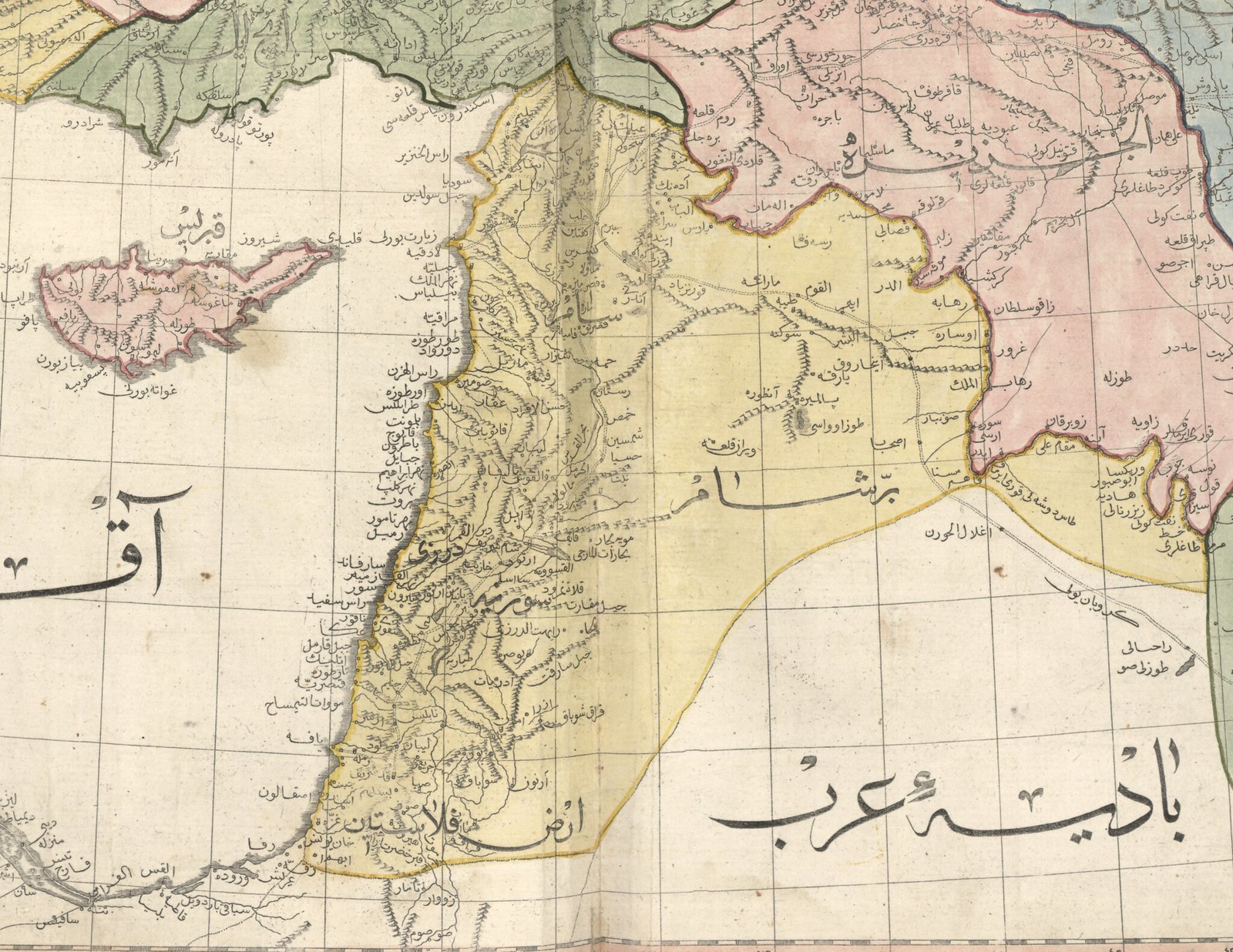
The Levant, and the region eventually designated “Palestine”, was, as history shows, a region always shuffled among dominant political powers. In the tragic sequence of oppression of the Hebrew-Semitic peoples, the ancient Judaic Kingdoms found themselves under foreign rule, the last of which leads to a dispersion of Judaic peoples throughout the Western (and Eurasian) world, and into the Arabian Peninsula in the desert south. In late antiquity, with the rise of another Semitic theologico-political order – Islam – we saw various Caliphates take over political governance of the region. But Act One ends (in about 70 CE) with the Roman-led destruction of the Second Temple in Jerusalem, and the ensuing Judaic diaspora. The Jews would henceforth find themselves a fragmented theologico-political group with no nation or geographical center formed by their own designs, instead bound by their religious-spiritual storytelling which kept the history of their oppression and exclusion a living reality, encoded in key texts and commentarial traditions (e.g. the Talmud).
Eventually, the Roman Empire morphs into the Byzantine (a Greek-inflected Imperium) as the Western Roman Empire collapses (in around 500 CE), and lasts until the great Islamic Conquests of the Seventh Century that lead to the formation of the Great Islamic Caliphates, which endure for centuries. Act Two ends with defeat of the Axis Powers of World War One by the Allies, which in turn ensures the collapse of the lumbering (and already moribund) Ottoman Empire – the last great Islamic Caliphate (the bane of the Arab Muslim world for centuries, and a motivating cause of the independence movements – in Egypt, Arabia, etc. – that peppered the Muslim world in the 19th and early 20th centuries). Overnight, the dominant political authority that had organized and effectively managed the region – Palestine – was gone. In its place, from on-high, there descended on the region some of the key Western Allied powers, still with a lingering (and soon-to-die) imperialism of their own: namely, the British and the French, who carved up the region like a Christmas goose, creating by paper fiat political borders that had little relation to existing ethnic-cultural identities or bonds – a situation all but guaranteed by the nebulous zone of political determination imposed by the Ottomans (who in any case just considered the region as a whole an extension of their own). From this borderless, now suddenly defunct, imperial zone of control was born a Franekstein’s monster by the new (albeit transitional) imperial overlords: “Mandatory Palestine,” now under the titular rule of the British.
Act Three of this tragedy ends with the fateful promise of the British to the leaders of the Zionist movement, who sought out a repetition of the legendary Promised Judaic Land: the recreation of a theologico-political order – a nation-state – for the diasporic Jews who had faced, for centuries, oppression and exclusion in Europe, Eurasia and elsewhere. Though not initially a target for this re-immigration program, Mandatory Palestine was eventually settled upon – for largely mythological (which is to say, theologico-religious) reasons: it was in truth where Judaism began long ago.
Finally, Act Four is the Nakba itself: the catastrophe. Only minutes after the British declared their exit from Mandatory Palestine, the Zionist leader Ben Gurion, as had been the plan, simply declared the formation of the State of Israel. The catastrophe here is simple: the declaration of a State of Israel, grounded in and motivated by the ideology of Zionism, had no corresponding declaration of statehood for the non-Jewish Muslim Arabs – who, in any case, had little to no participation in this fiat statehood. Indeed, the symbol chosen for the new state flag of Israel – the Star of David – is a specifically Jewish symbol, thus signaling in an instant that it was a religious group, and therefore an exclusionary group, that was in charge. It wasn’t the Muslims who got a state; it was the Jews. Hence, the enduring conflict which is the modern State of Israel – a state sadly inconceivable and even nonexistent without this conflict.
The horrible coda to this nakba which is Act Four of Palestine’s tragic story is the sequence of Arab or Muslim states, or internal Palestinian groups, who sought to fight on behalf of the now stateless Palestinian people – to give voice to the voiceless. And the latest episode of this catastrophic mini-series is the terrorist attack of 7 October perpetrated by Hamas against innocent civilians, while its mafiosi leaders pontificate for the Palestinian people and the cause of freedom in relative comfort, ensconced in luxurious enclaves in oil-rich Gulf statelets. What perhaps Hamas and similar mafia gangs fail to realize is the power and the meaning of the freedom they so want for the Palestinian people: it means and demands autonomy not only from the Israeli apartheid oppressors, but also from the tyranny of their own authoritarian “freedom” fighting which poses as a stand-in for the Palestinians themselves (a false – and forced – government of thugs). Autonomy means self-determination, not the rule by fear of the armed strongmen. If Hamas were to achieve its stated aims (the liberation of the Palestinian people by the destruction of the State of Israel), we would only have another Reign of Terror, an inversion of an already-immoral situation which would not achieve lasting peace or prosperity.
And here we find ourselves having to face a practical reality: that Israel has become, with the help of the U.S. and other Western allies, a powerful example of a liberal democracy bolstered by a strong and productive economy – the strongest in the region. The tragedy then is that something similar cannot be said for a Palestinian state. But we cannot reverse the tragic historical origins of Israel, as the U.S. cannot do for its own immoral past. The moral illegitimacy of Israel’s origins in a Zionist expropriation of indigenous Palestinian land can never be an argument for Israel’s extirpation or dissolution; but a recognition of the specific nature of these origins – whatever their moral status – in an asymmetrical fiat statehood can be used for the affirmation and creation of a parallel state that ought to have been formed at the same moment: the creation of an autonomous State of Palestine. This would be simultaneously a reckoning with Zionism as an exclusionary undemocratic founding ideology, and a recognition that such a mixture of politics and religion should never be the basis of modern state formation; the only price to be paid then by the Palestinians would be an equally religiously-neutral State, organized around the ethnic historical ties that bind a people together–a parallel Arab state that must seek peaceful coexistence with its Jewish-Israeli brothers and sisters.
I hope it is clear, then, that this anti-Zionist thesis is the very opposite of antisemitism, for it argues not for anything like the repudiation of the existing Jewish-Israeli State, or its destruction, or even for harm to be done (in vengeance or retribution for wrongs committed, which seems to be the factual motivating factor behind the Israeli War on Gaza) but only that the founding of the one out of need for the peace of a place of one’s own should equally apply for the Palestinians whose dwelling was expropriated on the basis of an exclusionary ideology of territorial reappropriation, which is what Zionism came to be, in actual practice and material social expression (the necessary passage from idea or ideology to material and social reality is a pathway that cannot be bypassed, for as Hegel realized, every idea finds its time in the concrete historical circumstances of the people the idea has captured).