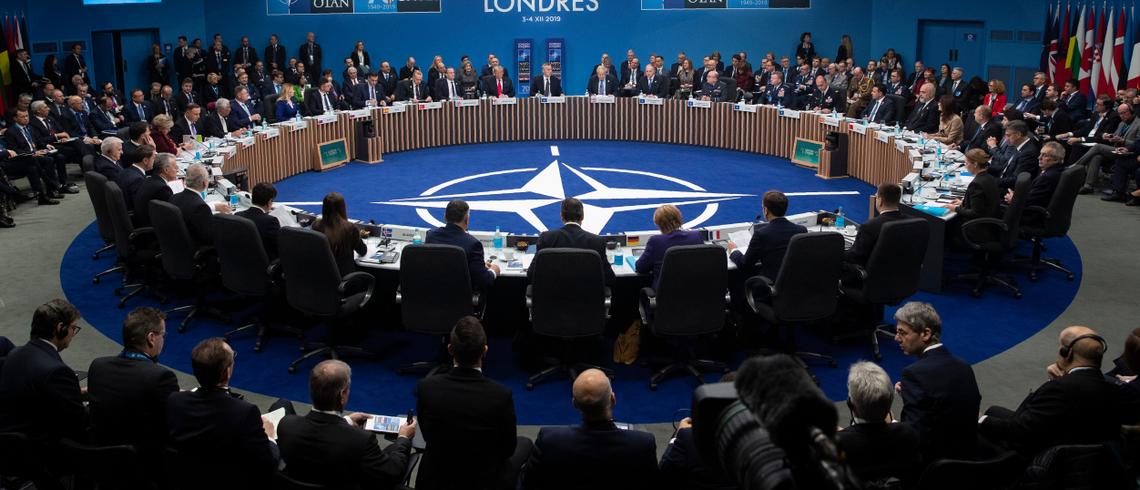
In a bizarre coincidence of opposites, the incessant attacks from the academic Left on American “Empire” and global hegemony, with its supposed blowback in the form of Putin’s military and cyber aggression challenging American and NATO supremacy, are matched by right-wing populist (ie Trumpist) blame-mongering which seeks to shoulder responsibility of the outbreak of war in the Ukraine onto America, with its disastrous roster of foreign policy blunders and fruitless interventionism. The academic Left and populist Right both want to see what is unfolding in the Ukraine as a US-generated crisis, with the US’s poor choice of foreign policy throughout the 1990s and into the early 2000s as proximate cause. For very different reasons, each side points to NATO and its “enlargement” as key to the problem.
For much of the academic Left, NATO represents not a defensive alliance so much as a political-economic (war) instrument for asserting American “world dominance” (as perhaps Chomsky would characterize it), an apparatus of US “imperial” power. For the (newer) Trumpist Right, it is an expensive and largely fruitless endeavor of the (bloated) US government which uses it to muck around in the affairs of nations we shouldn’t really be bothered with (“it’s not our problem” is perhaps the isolationist-Trumpist refrain for the regional conflicts in which NATO has intervened).
Perhaps both sides are committed to some kind of principle—largely tacit on the academic Left, but much more explicit on the populist Right—of American non-interventionism, if not military isolationism. Yet, the idea of a defensive alliance was crafted precisely to meet the dangers of inaction that attend a lack of decisive coordination among democratic nations faced with an existential threat, that is, when faced with a potential invader. Surely this must be the legitimate moral and political basis for an entity such as NATO. For different reasons such moral or political legitimacy is imperceptible to the academic Left and the populist Right.
In much of the discourse of the academic Left, it has become second nature to join the moral or political dimensions of global (or even regional) affairs to the economic. It is surely realistic to do so, for economics is a major determining factor of politics, and even to an extent shapes moral philosophy (though we may operate under the belief that it ought to be reversed). But equally surely this axiomatic conjunction is too “realistic” for it ignores that autonomy of ideals or principles which is the governing (moral) foundation of our political and economic practices. That there is a gap between principle and practice is no argument for the nonexistence of the former in favor of the latter (as Hegel well understood), nor for its impotency; rather that gap enables (and perhaps even defines) a notion of progress. Indeed, without it progress as such is inconceivable. But, perhaps as a consequence of the undue influence on the academic Left of Marx’s (largely inchoate or unfinished) materialist philosophy, a kind of “analytics of suspicion” reigns supreme where statements of principle by any military or political organization are met with a cynical skepticism—suspicion. This is of course not without justification in many cases, as it would be profoundly naïve to assume that statements of principle may not be nullified by the eventualities of action (speaking louder, as the saying goes, than the words). But we surely cannot allow this cautious (and prudent) “analytic of suspicion”, which checks the use of power against (we hope) higher moral principles than any one institution, often subject to multiple competing interests, can possibly maintain with consistency, to prevent us from seeing when and where an institution does have a moral legitimacy, when and where it can be made to obey its stated principles. That NATO may have been wrongly employed in some cases does not nullify its moral imperative in others. But in order to defend what legitimacy there is to the NATO alliance it is important that we distinguish— most especially “in theory” if not actually “in practice—its founding moral and political principles from the economic and “ideological” uses to which they are sometimes put. Insisting on this distinction provides the clarity necessary to not only establish legitimacy but to see it realized in actual policy. It must first be clear in theory before it can be sought in practice.
The entanglement between the moral/political principles, and the (exogenous) economic purposes to which the Alliance is sometimes, put was, I think, strengthened most by the ensuing loss of what Hegel might call NATO’s “negative identity” following the collapse of the Soviet Union—the Alliance’s raison d’être. During the post-war decades, as the Keynesian compromise was worked out (meant to save capitalist economies from the capitalist excesses of the early 20th century, and the ravages of WWII), there was an understanding that capitalist economic structures needed exogenous moral and political restraints, despite the undeniable practical realities of economic interests being a driving force for both moral and political life (one might call this economically-driven constellation of ideas “ideology”). Without such restraint, it was argued, we might see a repeat of the economic crises that precipitated the two world wars.
But, as the American theologian Reinhold Niebuhr knew so well, one of the many (unfortunate) “ironies” of American history was that America lacked a meaningful tradition of robust moral-philosophical challenge to capitalist economy—America was “born bourgeois” and thus knows nothing else. To attempt to challenge the structures of capitalism in the US is tantamount to attacking America itself: the “American Way of Life”. In Europe, of course, such a tradition of moral-philosophical challenge does exist—after all there were centuries of European social life prior to the emergence of capitalism as a specific political and economic philosophy—and hence there is an underlying social and political philosophy available to restrain the excesses of unfettered capitalism. That the US would take the lead in the formation of NATO, then, has profound implications, as this would prime the Alliance to become in time an instrument to realize (frequently covert) economic interests as it used the rhetoric of “freedom” and “democracy” to explain its defensive aims—mirroring the internal political disposition of the US as a whole.
As the Second World War war became but a distant memory, the business of European reconstruction was underway (the Marshall Plan). The U.S., flush with cash and industrial might, itself untouched by the ravages of war, soon becomes obsessed with the evils of the Soviet Union—“communism”—and sees the post-war compromise of restrained capitalism gradually morph into an almost desperate attempt to reinvigorate capitalist economies as stagflation took hold in the core powers. Enter “neoliberalism”.
In the neoliberal age of increasingly strident and unabashed capitalist triumphalism (think the Regan-Thatcher years), NATO comes to represent (to those in the Soviet Bloc) more an instrument of capitalist “imperialism” or (for those in the Alliance itself) the axiomatic conjunction “democracy and free markets”. That is, given the new unshakeable faith in the necessary conjunction of capitalism and democracy (which holds that market freedom is the required condition for democracy itself), NATO was to defend capitalist political economy as a requirement of democracy. But this neoliberal capitalist order, the cause of so much of today's politics of suspicion (voiced within this strange coincidence of opposites the left and right have struck upon), has effectively come to an end; or, taking a more moderate (!) view, has really entered terminal decline (which has been the argument of political economist Wolfgang Streeck, as we see precisely argued in this lecture of January 2019 at the University of Manchester). What we in fact see, Michael Beckley persuasively argues in a recent edition of Foreign Affairs, is the emergence of an entirely new international order.
This new international order is a consequence of the antagonism now clearly forming and intensifying along two moral-political axes, with versions of illiberal authoritarianism on the one side and liberal democracies on the other. Since almost every authoritarianism participates in some form of capitalism—from China and Russia, to the left-wing governments of Latin America (we say almost, excepting the near autarkies of Venezuela, North Korea and Iran given that status by heavy Western economic sanctions, with Russia fast approaching this status too)—the only thing left to distinguish other nations, including the major Western powers, from this autocratic group is democracy itself. In other words, it is becoming clear that the only point of contestation with China and its cooperative allies is liberal democracy, which, in order to constitute a robust and real contrast, forces the old neoliberal order to adopt a new vision, a new ideology we might say, one that is no longer about how capitalism is the road to freedom, but how only in a democracy can that freedom necessary for capitalism be secured (where the implication is that capitalism is but one aspect of a larger sociopolitical whole). That is, the order of importance has, rather dramatically, shifted: democracy is fundamental to capitalist economy—not the other way round. "By infusing labor and human rights standards into economic agreements," writes Beckley, "the new vision prioritizes people over corporate profits and state power. It also elevates," he continues,
the global environment from a mere commodity to a shared and jointly protected commons. By linking democratic governments together in an exclusive network, the new order attempts to force countries to make a series of value judgments and impose real penalties for illiberal behavior. (March/April 2022 edition; p. 81)
But the "history of international order building," Beckley argues, striking a very realistic note, "is one of savage competition between clashing systems, not of harmonious cooperation" (ibid.). The antagonism and competitiveness are what drives the formation of the international order; they are its essential dynamics. Here, the dimension of Hegelian "negative identity" returns as the crucial element on the international scene—referred to by Beckley in more concrete ways as the sociological "in-group/out-group dynamic" or Sallust's Theorem, or, in political science, "negative partisanship ... the tendency for voters to become intensely loyal to one political party mainly because they despise its rival" (pp. 70-71). Thus, following a kind of post-modern interlude of unchallenged supremacy, brought about by the sudden disappearance (literally overnight) of the superpower against which the liberal democratic order had come to define itself, neoliberalism quite ironically could not sustain itself without a serious challenger to its identity. Lacking this challenge, neoliberalism quickly entered into an unsustainable phase, with increasingly strident globalist and internationalist political elites arguing for more and more locally (which is to say nationally or regionally) disagreeable trade deals, agreements and pacts. And for all of its political ideology of inclusion, it turned out that the neoliberal order was anything but. "By promoting free markets, open borders [both key to the globalist economy and therefore essential to the centrist parties dominating the politics of rich Western powers], democracy, supranational institutions, and the use of reason to solve problems," argues Beckley, "the order challenges traditional beliefs and institutions that have united communities for centuries: state sovereignty, nationalism, religion, race, tribe, family." And in this way, "by slaying its main adversary [the "illiberal" order represented by this veritable "basket of deplorables": tribalism, nationalism, etc., to borrow H.R. Clinton's formula], the liberal order unleashed all sorts of nationalist, populist, religious and authoritarian opposition" (p. 72). Does this not sum up the "grievances" Mr. Putin has with "The West"? Does it not also sum up those which Trump so strategically, if inelegantly, tapped into in his election campaign and during his (endlessly scandal-ridden) presidency?
If there is indeed a new antagonism against which liberal democracies can now defines themselves—one which forces democracy itself into a position of fundamental importance—then NATO can be understood as an authentic defensive alliance. It would be one necessary and well-justified given this new Sino-Russian antagonism, the new democracy-autocracy fault line quickly and openly forming on the international stage. If neoliberalism (what Beckley called the "old order") has effectively come to an end with these new circumstances, and there is an authentic dispute between competing values, then we may ditch the politics of suspicion (and the endless subtleties of academic criticism, American declinist narratives, etc.—the staple of the academic hard Left, followed in recent times by even more right-wing commentators).
After cynicism, after the politics of suspicion, what is left? What is left is the practical necessity of having to choose—to choose between the actual options on the table: the democratic alliances, or the autocrat's paradise. Present circumstances finally requires one to hazard a belief in something, an informed and one might dare say "enlightened" belief in an alliance that has the best chance to continue to be a bastion of freedom and self-determination, and the rule of law. On the world stage, we make this binary choice in favor of the morally superior of the options: liberal democracy. At home, we continue our struggle to achieve more fully and more perfectly in practice what (on the world stage, in diplomacy) we preach in theory for all.
Shall we, then, risk to be filled with the passion of conviction that our democratic option, open to all, where all can live together with all, might be made better?